

5 Key Requirements for Gears Used in Marine Power Transmission
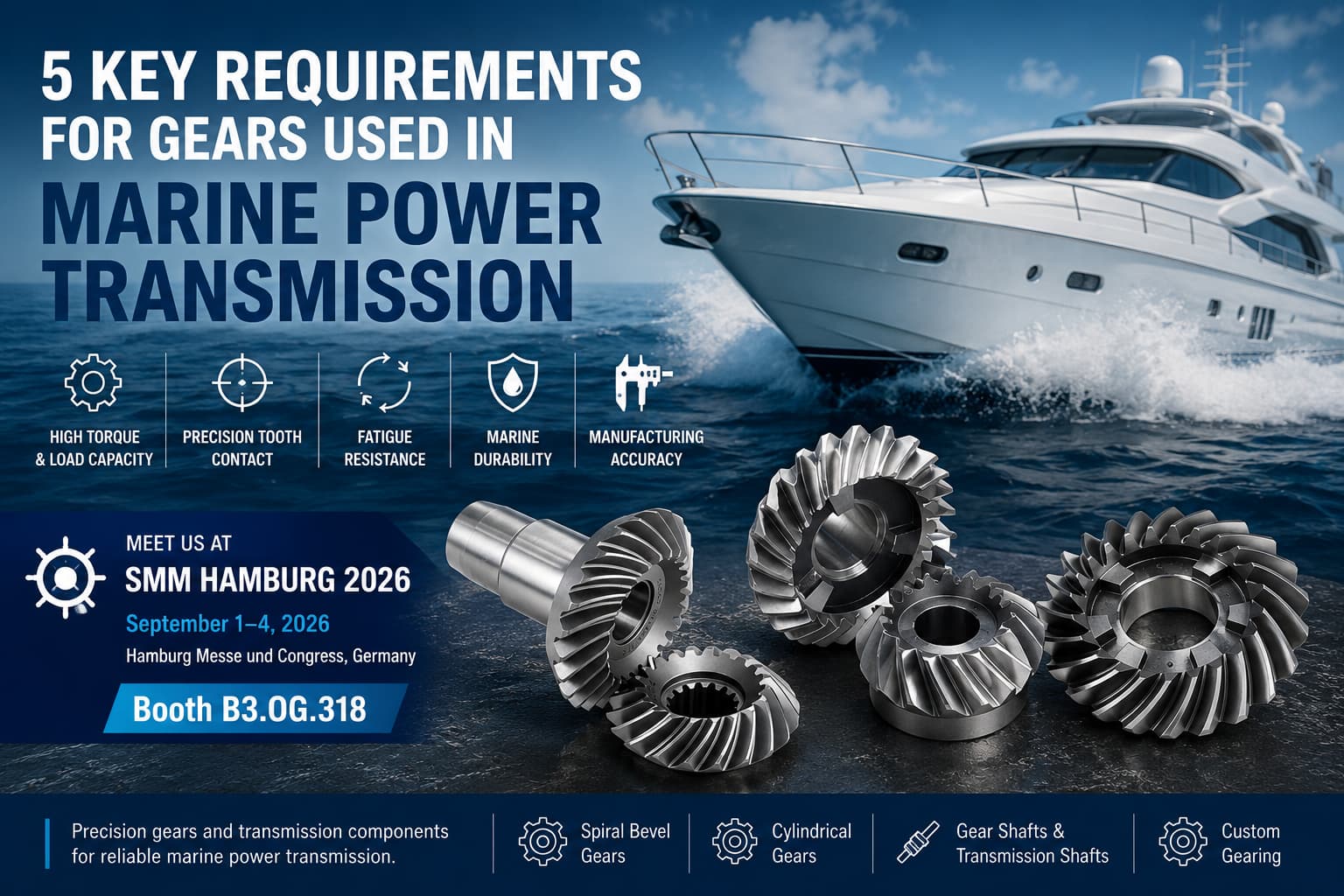
Marine power transmission systems operate under conditions that can be very different from those of conventional industrial machinery. From outboard engines and propulsion systems to other marine transmission equipment, gears must transfer power reliably while handling high torque, continuous operation, vibration, and exposure to challenging marine environments.
Minchen Gear has experience manufacturing gears and related components for outboard engine and motor applications, providing a practical manufacturing foundation for demanding marine power transmission requirements.
A gear that performs well in a general industrial application may not automatically be suitable for marine use. Gear type, load capacity, tooth accuracy, material, surface treatment, and operating environment all need to be considered according to the actual transmission design.
For marine equipment manufacturers and power transmission engineers, the following five factors are particularly important when evaluating gears for marine applications.
1. High Torque and Load Capacity
Marine propulsion systems must transfer engine power efficiently through the drivetrain to generate propulsion. Depending on the equipment design, gears may experience high torque as well as changing loads during acceleration, deceleration, maneuvering, and changes in operating conditions.
For this reason, gear strength and load distribution are critical.
Important factors include:
- Gear material
- Tooth geometry
- Gear size and ratio
- Heat treatment
- Surface hardness
- Tooth contact pattern
- Actual operating torque
For demanding applications, forged gears can provide improved mechanical strength and fatigue resistance. Gear design and manufacturing quality must then ensure that the transmitted load is distributed across the intended tooth contact area rather than concentrated locally.
At Minchen Gear, our experience includes producing Forged Gears for Outboard Engines and other precision gears according to customer requirements.
2. Precision Tooth Contact for Smooth Power Transmission
High strength alone does not guarantee reliable gear performance. Tooth geometry and contact accuracy are equally important.
If the actual tooth contact differs significantly from the intended design, load may become concentrated in a smaller area. This can contribute to abnormal wear, vibration, noise, and premature surface fatigue.
This is particularly important for spiral bevel gears, which are widely used where power needs to be transmitted between intersecting shafts.
Their curved tooth geometry provides gradual engagement, helping support smooth power transmission and load distribution when the gear pair is correctly designed, manufactured, and assembled.
Minchen Gear manufactures Spiral Bevel Gears for Outboard Engine applications, including gears used to transfer power through the lower unit toward the propeller shaft.
3. Resistance to Continuous Operation and Fatigue
Marine power transmission components may operate for extended periods rather than only in short cycles. Repeated loading over thousands or millions of gear engagements creates fatigue stress at both the tooth root and tooth surface.
Over time, insufficient fatigue strength or unfavorable load distribution may contribute to problems such as:
- Tooth root cracking
- Surface pitting
- Progressive wear
- Tooth damage
- Premature gear failure
Long service life therefore depends on more than simply selecting a strong material.
Material properties, forging quality, heat treatment, tooth geometry, surface condition, and manufacturing accuracy all work together to determine how well a gear handles repeated loads.
For more information about how forging influences gear strength and fatigue performance, see How the Forging Process Enhances Gear Strength and Performance.
For marine equipment manufacturers, these factors should be evaluated according to the actual duty cycle rather than only the maximum rated load.
4. Durability in Marine Operating Environments
The marine environment introduces another challenge: water, salt, humidity, and temperature changes.
These conditions can increase the risk of corrosion and lubricant contamination, particularly if sealing or maintenance is inadequate. Once gear surfaces deteriorate, the original tooth contact condition may change and wear can accelerate.
Marine gear reliability therefore needs to consider the entire operating environment, including:
- Material selection
- Surface treatment
- Lubrication
- Sealing
- Corrosion protection
- Maintenance intervals
Minchen Gear's experience with outboard engine gears includes applications where components must maintain reliable power transmission while operating under demanding marine conditions.
The correct material and treatment should always be selected according to the customer's actual operating environment and engineering requirements.
5. Manufacturing Accuracy and Quality Control
Even when the correct gear type and material have been selected, manufacturing accuracy can ultimately determine whether the finished gear performs as intended.
Small deviations in tooth profile, pitch, runout, or contact pattern can affect:
- Load distribution
- Noise and vibration
- Transmission efficiency
- Wear characteristics
- Gear service life
This makes precision manufacturing especially important for spiral bevel and other high-performance gear applications.
At Minchen Gear Co., Ltd., our manufacturing capabilities include advanced GLEASON and KLINGELNBERG gear manufacturing equipment. Our CNC Gear Cutting Machines support precision gear production where accurate and repeatable tooth geometry is required.
For marine equipment manufacturers working from established designs, Minchen can manufacture custom gears according to customer drawings and specifications.
What Gear Types Are Used in Marine Power Transmission?
The appropriate gear depends on the transmission layout, shaft arrangement, torque, speed, ratio, available installation space, and other design requirements.
Minchen's Outboard Engine / Motors gear range demonstrates our experience with several types of power transmission components for marine applications.
Spiral Bevel Gears
Suitable for transmitting power between intersecting shafts. In outboard engines, spiral bevel gears can be used in the lower unit to transfer power toward the propeller shaft while providing smooth tooth engagement.
Explore Minchen's Spiral Bevel Gear solutions for Outboard Engines.
Cylindrical Gears
Depending on the transmission design, spur and helical gear configurations can be used for parallel-shaft power transmission.
Forged Gears
Forged components can be selected for applications requiring greater strength and resistance to demanding loads.
Explore Minchen's Forged Gear solutions for Outboard Engines.
Gear Shafts and Transmission Shafts
Shaft components play an essential role in transferring rotational power through the drivetrain while maintaining the alignment required by the transmission system.
Minchen also manufactures Shafts for Outboard Engine applications according to customer requirements.
The appropriate solution should ultimately be determined from the customer's drawings, torque, speed, load, shaft arrangement, operating environment, and other technical requirements.
Minchen Gear's Experience in Marine and Outboard Engine Applications
Minchen Gear has applied its gear manufacturing capabilities to forward and reverse gears for outboard engines of different horsepower, as well as related turning, milling, and forged components.
Our Outboard Engine / Motors application and product range demonstrate experience with forged gears, multiple spiral bevel gear configurations, shafts, and other components designed for marine power transmission requirements.
Combined with our experience in precision bevel gear manufacturing, this allows us to support customers who require custom gear components based on their own transmission designs and drawings.
Meet Minchen Gear at SMM Hamburg 2026
If you are currently developing a marine propulsion system, transmission assembly, or custom marine power transmission component, there will also be an opportunity to discuss your requirements directly with the Minchen Gear team this September.
Minchen Gear Co., Ltd. will exhibit at SMM Hamburg 2026, one of the major international events for the maritime industry.
At the exhibition, we will present our marine power transmission capabilities, including:
- Spiral Bevel Gears
- Cylindrical Gears
- Gear Shafts
- Transmission Shafts
- Custom Gearing
- Power Transmission Components
- Gear and Transmission System Solutions
SMM Hamburg 2026
Date: September 1–4, 2026
Venue: Hamburg Messe und Congress, Hamburg, Germany
Booth: B3.OG.318
If you are looking for a gear manufacturing partner for marine equipment, bring your application requirements, drawings, torque and speed requirements, or transmission challenges to our booth. Our team looks forward to discussing your project in Hamburg.
Frequently Asked Questions
What types of gears are commonly used in marine power transmission systems?
The gear type depends on the transmission design. Spiral bevel gears are commonly used to transmit power between intersecting shafts, while spur and helical gears can be used for parallel-shaft transmission. Gear shafts, transmission shafts, and forged gear components may also be required depending on the system.
Why are spiral bevel gears suitable for marine propulsion applications?
Their curved tooth geometry enables gradual tooth engagement and can provide smooth power transmission and effective load distribution. In outboard engines, they can be used to transfer power through the lower unit toward the propeller shaft.
What information should be provided when requesting a custom marine gear?
Providing drawings is the best starting point. Information about gear geometry, material requirements, torque, speed, ratio, shaft arrangement, heat treatment, accuracy requirements, quantity, and operating conditions can also help determine the appropriate manufacturing process.
Can Minchen manufacture marine gears according to customer drawings?
Yes. Minchen Gear provides custom gear manufacturing based on customer requirements and produces a range of precision gears and transmission components for marine and outboard engine applications.
Conclusion
Reliable marine power transmission depends on more than selecting a particular gear type. Torque capacity, tooth contact accuracy, fatigue resistance, environmental durability, and manufacturing precision all influence how a gear performs throughout its service life.
For marine equipment manufacturers, considering these requirements early in the development process can help reduce premature wear, improve transmission reliability, and ensure that the finished gear matches the intended operating conditions.
With experience in outboard engine gears and precision power transmission components, Minchen Gear Co., Ltd. supports custom manufacturing based on customer drawings and application requirements.
If you are searching for a marine gear manufacturing partner, visit Minchen Gear at SMM Hamburg 2026, Booth B3.OG.318, from September 1–4, 2026, and discuss your next marine power transmission project with our team.