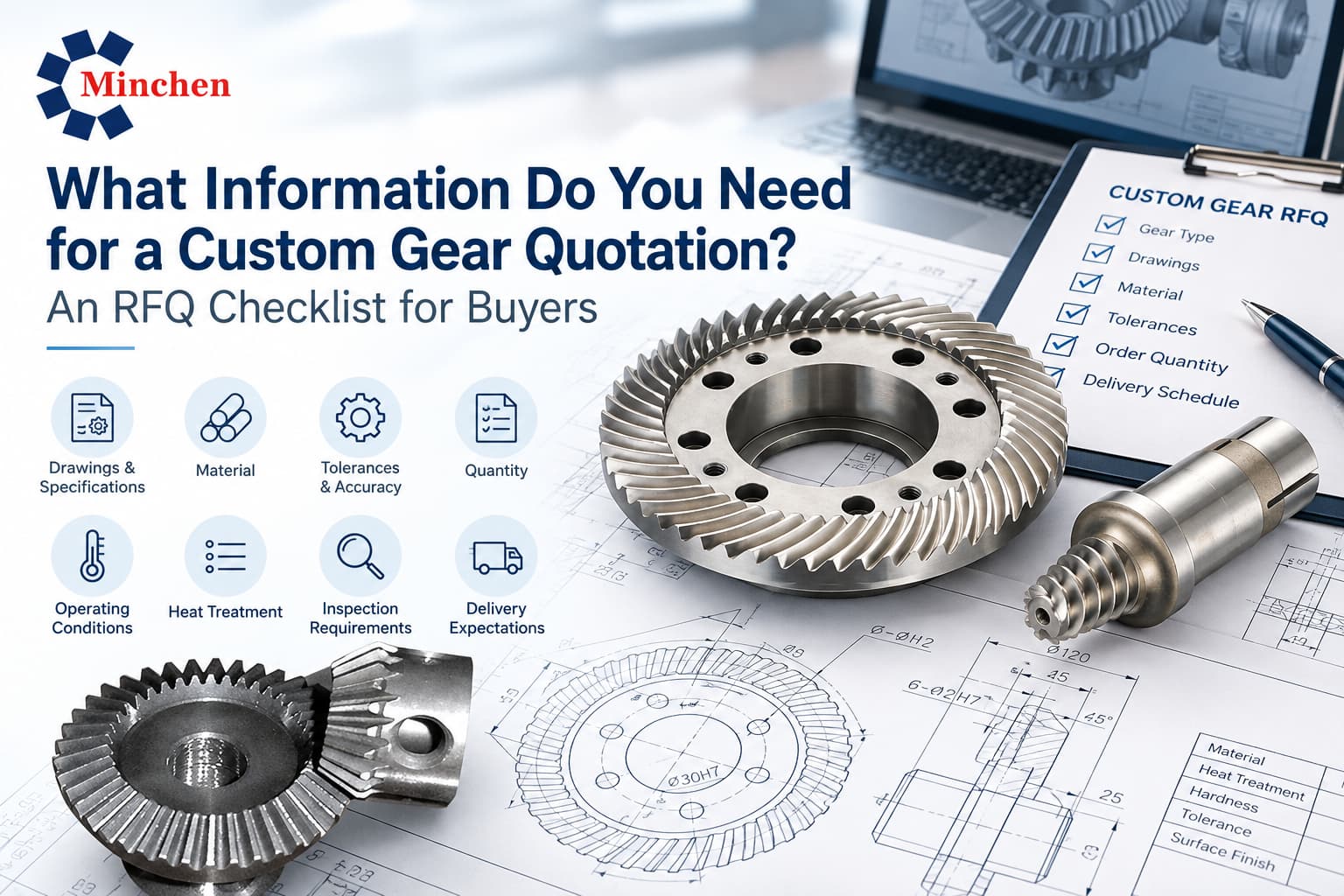
Requesting a custom gear quotation involves more than sending a drawing and asking for a price. Gear manufacturers need accurate technical and purchasing information to evaluate production feasibility, manufacturing costs, inspection requirements, and lead times.
To request a custom gear quotation, buyers should provide the gear type, technical drawings or available dimensions, tooth specifications, material requirements, accuracy and tolerances, order quantity, and delivery expectations. Depending on the application, heat treatment, operating conditions, mating gear details, and inspection documentation may also be necessary.
This guide provides a practical custom gear RFQ (Request for Quotation) checklist to help OEM buyers, engineers, and procurement teams prepare complete inquiries and reduce unnecessary clarification during the quotation process.
1. What Information Is Required for a Custom Gear Quotation?
A custom gear RFQ should contain enough information for the manufacturer to understand the required component, evaluate manufacturing feasibility, and estimate production costs.
The most important information falls into five categories:
- Gear specifications: Gear type, tooth geometry, dimensions, and mounting features.
- Material and performance requirements: Material grade, heat treatment, operating load, and environmental conditions.
- Accuracy and quality requirements: Dimensional tolerances, gear accuracy, and inspection criteria.
- Production requirements: Prototype quantities, production volumes, and estimated annual demand.
- Delivery requirements: Target delivery date, shipping destination, and applicable commercial requirements.
Not every specification must be finalized before an initial inquiry. However, buyers should clearly distinguish confirmed requirements from information that still requires engineering review.
| RFQ Information | Priority | Purpose |
|---|---|---|
| Gear type and basic geometry | Essential | Identifies the required gear configuration |
| Technical drawing or dimensional information | Essential for initial review | Supports feasibility and cost evaluation |
| Material specification | Essential or to be discussed | Defines manufacturing and performance requirements |
| Heat treatment | If applicable | Identifies hardness and processing requirements |
| Gear accuracy and tolerances | Application-dependent | Establishes manufacturing and inspection criteria |
| Operating conditions | Recommended | Helps evaluate application suitability |
| Order quantity | Essential | Supports production and pricing calculations |
| Delivery expectations | Recommended | Helps evaluate scheduling requirements |
| Inspection documentation | If required | Clarifies quality verification expectations |
Key Takeaway: A complete RFQ does not necessarily require a finalized design, but it should clearly communicate the available specifications, purchasing requirements, and unresolved technical questions.
2. What Drawings and Gear Specifications Should You Submit?
A custom gear quotation should ideally include a dimensioned 2D engineering drawing and, when available, a 3D CAD model. These documents help manufacturers understand the required geometry, mounting features, tolerances, and manufacturing requirements.
A 2D drawing should communicate specifications that may not be fully represented in a 3D model, such as material grades, dimensional tolerances, surface finish, and inspection notes.
Essential Gear Specifications
Depending on the gear type, buyers should prepare:
- Module (m) or diametral pitch (DP)
- Number of teeth
- Pressure angle
- Face width
- Outside diameter and bore dimensions
- Keyway, spline, or mounting features
- Required dimensional tolerances
- Mating gear information, when applicable
Do Different Gear Types Require Different RFQ Details?
Yes. Different gear configurations require different technical information.
| Gear Type | Additional Information to Consider |
|---|---|
| Spur Gear | Tooth count, module or DP, pressure angle, face width, and mounting dimensions |
| Helical Gear | Helix angle, helix direction, and the reference system used for module and pressure angle |
| Straight Bevel Gear | Shaft angle, mating gear specifications, and relevant pitch cone geometry |
| Spiral Bevel Gear | Shaft arrangement, mating gear information, tooth geometry, and required contact characteristics |
For bevel and spiral bevel gears, information about the mating gear set is especially important because tooth geometry and meshing performance depend on the intended gear pair and assembly arrangement.
Can You Request a Quotation Without Complete Drawings?
Buyers may begin an initial discussion using existing samples, photographs, known dimensions, or application information.
However, additional engineering information may be required before the manufacturer can confirm production feasibility or provide a firm quotation.
If reverse engineering is necessary, the required scope and responsibilities should be discussed separately.
Key Takeaway: Provide complete drawings whenever possible, and include mating gear information when the design depends on an existing transmission assembly.
3. How Do Materials, Heat Treatment, and Operating Conditions Affect an RFQ?
Material selection, heat treatment, and operating conditions influence manufacturing processes, gear performance, and quotation costs.
Two gears with similar dimensions may require different production methods because of differences in strength, hardness, wear resistance, or operating loads.
Material Requirements
Buyers should specify the required material grade when it has already been determined.
Material selection may depend on:
- Required strength and toughness
- Wear resistance
- Machinability
- Heat-treatment compatibility
- Operating environment
- Applicable design or industry requirements
If the material has not been finalized, buyers should provide the intended application and performance requirements for further technical discussion.
Heat Treatment Requirements
Common gear heat-treatment processes include carburizing, induction hardening, and through hardening.
Depending on the application, buyers may need to specify:
- Surface hardness
- Core hardness
- Effective case depth
- Applicable heat-treatment standards
- Dimensional requirements after heat treatment
The appropriate process depends on the material, gear geometry, and performance requirements.
Operating Conditions
Operating conditions provide important context for evaluating the specified gear design.
Relevant information may include:
- Transmitted torque and rotational speed
- Duty cycle and expected service life
- Shock loads or reversing loads
- Lubrication conditions
- Operating temperature
- Exposure to dust, moisture, or contamination
For example, gears used in agricultural machinery may experience fluctuating loads, shock loading, and contamination. These conditions can influence material selection, heat treatment, and durability requirements.
Key Takeaway: Providing operating conditions helps clarify whether the proposed gear specifications are suitable for the intended application. Any design verification or engineering assessment should be agreed upon with the manufacturer.
4. What Gear Tolerances and Inspection Requirements Should You Specify?
A custom gear RFQ should identify the accuracy and inspection requirements that are important to the application.
Gear accuracy affects manufacturing complexity, inspection procedures, and potentially the quotation price. However, tighter tolerances do not automatically guarantee better performance.
Common Accuracy and Inspection Requirements
Depending on the gear type, important characteristics may include:
- Tooth profile deviation
- Lead or tooth trace deviation
- Pitch deviation
- Radial runout
- Bore and mounting surface tolerances
- Surface finish
- Tooth contact pattern, where applicable
For applicable cylindrical gears, buyers may reference ISO 1328 when specifying gear accuracy characteristics.
The relevant standard, edition, accuracy grade, and inspection characteristics should be clearly identified.
Other gear types, including bevel gears, may require different standards or measurement approaches.
What Quality Documents Should Be Included in an RFQ?
Depending on the application, buyers may request:
- Dimensional inspection reports
- Gear measurement records
- Material certificates
- Heat-treatment reports
- Additional agreed inspection documentation
These requirements should be identified during quotation because inspection procedures and documentation can influence manufacturing costs and delivery schedules.
For further guidance on evaluating gear quality, read MINCHEN's article, Looking for High-Quality Gears? 5 Quality Checks to Make Before Choosing a Supplier .
Key Takeaway: Specify the tolerances and inspection documents required by the application rather than requesting unnecessarily high accuracy across every characteristic.
5. How Do Order Quantity and Lead Time Affect Custom Gear Pricing?
Order quantity and delivery requirements influence how manufacturers estimate custom gear production costs.
Prototype production may involve engineering review, setup, tooling, and inspection costs distributed across a relatively small number of components.
Larger production volumes may allow certain fixed costs to be spread across more units, although actual pricing depends on the gear design and manufacturing processes.
What Purchasing Information Should You Provide?
| Purchasing Detail | Information to Include |
|---|---|
| Prototype Quantity | Number of gears required for testing or validation |
| Initial Order Quantity | Expected quantity for the first production order |
| Annual Demand | Estimated yearly purchasing volume |
| Repeat Orders | Whether regular production is expected |
| Target Delivery Date | Required date for samples or production parts |
| Delivery Destination | Shipping country or location and relevant delivery terms |
Buyers should also clarify whether they need prototype pricing, production pricing, or both.
Why Can Similar Gears Have Different Prices?
Even gears with similar dimensions can have different manufacturing costs because of variations in:
- Material grade
- Gear geometry and complexity
- Heat-treatment requirements
- Machining and finishing processes
- Accuracy and inspection requirements
- Production quantity
For this reason, comparing quotations based only on unit price may not provide a complete picture.
Buyers should also review the quoted specifications, included processes, inspection scope, and commercial terms.
Key Takeaway: Providing realistic production quantities and delivery expectations helps manufacturers prepare quotations that better reflect the project's actual requirements.
6. Custom Gear RFQ Checklist: What Should You Verify Before Submitting?
Before contacting a custom gear manufacturer, review the following checklist to identify the information you have prepared and any details that still need clarification.
Technical Requirements
- Gear type and intended application
- 2D engineering drawing or available dimensional information
- 3D CAD model, if available
- Tooth specifications and critical dimensions
- Mating gear or assembly information, if applicable
Material and Performance Requirements
- Material grade or required performance characteristics
- Heat treatment and hardness requirements, if applicable
- Torque, speed, and operating conditions
- Environmental or service-life requirements
Quality Requirements
- Applicable accuracy standards and tolerances
- Critical inspection characteristics
- Required inspection reports or certificates
Purchasing Requirements
- Prototype quantity
- Initial production quantity
- Estimated annual demand
- Target delivery date and destination
- Contact information and outstanding technical questions
What if Some Information Is Missing?
A complete RFQ checklist helps streamline the quotation process, but buyers do not need to finalize every technical detail before making an initial inquiry.
Clearly identify which requirements are confirmed, which are preliminary, and which require further discussion.
This allows both parties to establish the next steps before proceeding with a final quotation or production approval.
Request a Custom Gear Quotation from MINCHEN GEAR
Minchen Gear Co., Ltd. specializes in precision gear manufacturing and custom gear solutions for industrial applications.
For OEM and ODM projects, clearly defined gear specifications, production quantities, and quality expectations help establish a more efficient technical discussion.
Whether your project involves spur gears, helical gears, bevel gears, spiral bevel gears, or other customized gear components, preparing a structured RFQ is an important first step.
Ready to discuss your custom gear requirements?
Prepare your available drawings, technical specifications, and purchasing information, then contact MINCHEN GEAR to discuss your project and quotation requirements.
Request a Custom Gear Quotation7. Frequently Asked Questions About Custom Gear Quotations
Q1. Can I request a custom gear quotation without a complete drawing?
Yes. Buyers may begin an initial inquiry using an existing gear sample, photographs, known dimensions, or application requirements. However, complete technical specifications may be necessary before the manufacturer can confirm feasibility and provide a firm quotation. Any reverse-engineering requirements should be discussed separately.
Q2. What information is most important for a custom gear RFQ?
The most important information generally includes gear type, geometry, material, accuracy requirements, order quantity, and intended application. For gears that must mesh with existing components, mating gear specifications may also be essential. The exact requirements depend on the gear design and manufacturing process.
Q3. Do I need to specify gear accuracy before requesting a quotation?
Buyers should identify critical tolerances and applicable accuracy requirements whenever possible. If the required accuracy has not been finalized, provide the application, operating conditions, and assembly requirements for technical discussion. Final specifications should be confirmed before production.
Q4. Can I request both prototype and mass-production pricing?
Yes. Buyers can request separate quotations for prototype and production quantities. Providing estimated annual demand may also help the manufacturer evaluate production planning and potential pricing differences. Prototype and production quotations may have different cost structures.
Q5. How long does it take to receive a custom gear quotation?
Quotation time depends on the completeness of the technical information, gear complexity, manufacturing feasibility, and required engineering review. Providing clear drawings, specifications, quantities, and delivery expectations can reduce unnecessary clarification, but the actual quotation schedule should be confirmed with the manufacturer.
 BACK