2026-07-20
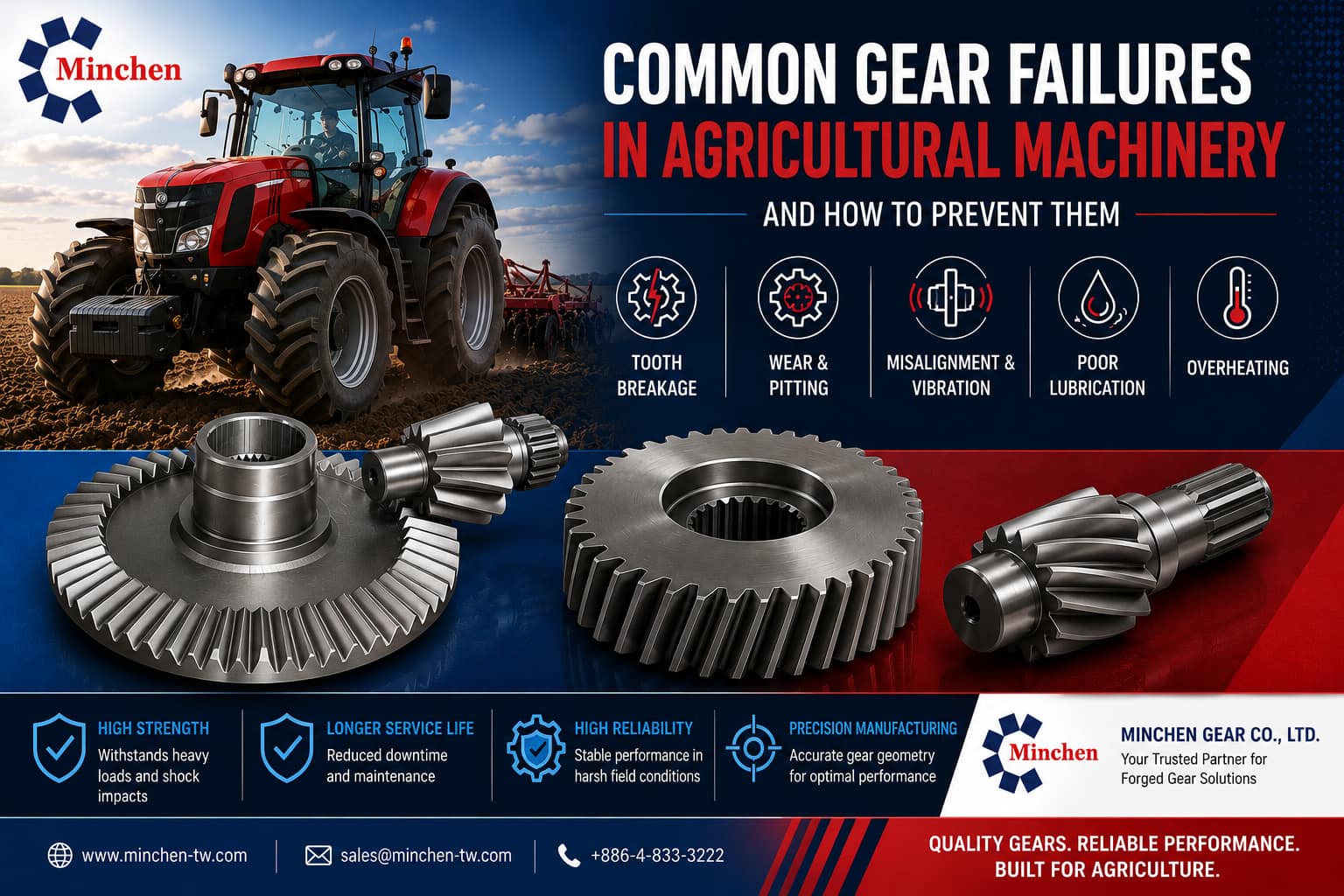
In this article, we'll explore the most common gear failures found in agricultural machinery and discuss practical ways to prevent them.
Introduction
Agricultural machinery operates in some of the harshest environments of any industry. Tractors, harvesters, seeders, tillage equipment, and sprayers are constantly exposed to heavy loads, sudden impacts, dust, mud, moisture, and long operating hours. These demanding conditions place tremendous stress on every drivetrain component—especially the gears responsible for transmitting power throughout the machine.
When gear failures occur, they can lead to costly downtime, expensive repairs, and reduced productivity during critical farming seasons. Fortunately, many of these failures can be prevented through proper gear design, precision manufacturing, appropriate materials, and regular maintenance.
In this article, we'll explore the most common gear failures found in agricultural machinery and discuss practical ways to prevent them.
Why Agricultural Gears Fail
Unlike equipment used in controlled factory environments, agricultural machinery must continuously adapt to changing field conditions. Gears often experience:
- Heavy torque transmission
- Sudden shock loads
- Dirt, sand, and moisture contamination
- Continuous cyclic loading
- Temperature fluctuations
These harsh operating conditions make agricultural gears more susceptible to wear and damage if they are not properly manufactured or maintained.
1. Gear Tooth Breakage
Broken gear teeth are among the most serious failures because they usually result in immediate machine downtime.
Common Causes
- Excessive torque
- Sudden impact loads
- Poor material quality
- Improper heat treatment
- Manufacturing defects
For example, tractors working in rocky soil or harvesters processing dense crops may experience unexpected torque spikes that exceed the gear's design capacity.
How to Prevent It
Using forged gears significantly improves impact resistance and fatigue strength. Combined with premium alloy steel and proper heat treatment, forged gears are better equipped to withstand demanding agricultural applications.
If you'd like to learn more about why forging is widely used in agricultural machinery, read our related article:
Why Forged Gears Are Preferred in Agricultural Equipment
2. Surface Wear and Pitting
Surface wear and pitting are common problems caused by repeated contact stress between meshing gear teeth.
Typical causes include:
- Poor lubrication
- Dust and abrasive contamination
- Improper tooth contact
- Insufficient surface hardness
Although pitting often starts as tiny surface defects, it can gradually spread across the gear teeth and reduce transmission efficiency.
How to Prevent It
Proper lubrication is the first line of defense. In addition, precision-manufactured gears with accurate tooth profiles help distribute loads evenly and minimize localized contact stress.
For more information about precision gear manufacturing, see:
Understanding Spiral Bevel Gear Manufacturing: Key Techniques and Quality Standards
3. Misalignment and Excessive Vibration
Even high-quality gears can fail prematurely if they are not properly aligned.
Misalignment may result from:
- Worn bearings
- Shaft deflection
- Housing deformation
- Poor machining accuracy
When gears do not mesh correctly, vibration increases and tooth loading becomes uneven, accelerating wear and shortening service life.
How to Prevent It
Regular inspection of shafts and bearings is essential. More importantly, gears should be manufactured with high dimensional accuracy to ensure proper tooth contact throughout operation.
How Precision Manufacturing Prevents Gear Failures
Many gear failures actually originate during manufacturing rather than during operation. Small deviations in tooth geometry, pitch accuracy, or surface finish can significantly reduce gear life under heavy agricultural workloads.
At Minchen Gear Co., Ltd., precision manufacturing is the foundation of every gear we produce. Our production process combines advanced CNC equipment with strict quality control to ensure consistent performance in demanding agricultural applications.
Precision CNC Gear Cutting
Using advanced GLEASON PHOENIX® and KLINGELNBERG CNC gear cutting machines, we produce highly accurate bevel and hypoid gears with consistent tooth geometry and excellent transmission performance.
Learn more about Minchen's CNC cutting machines
Precision Gear Grinding
For applications requiring smoother operation and tighter tolerances, precision grinding improves tooth accuracy, reduces vibration, and extends gear life.
Gear Inspection
Every gear undergoes comprehensive inspection to verify tooth profile, pitch accuracy, runout, and contact patterns before shipment.
By combining advanced manufacturing equipment with rigorous inspection procedures, Minchen Gear helps customers reduce the risk of premature gear failure while improving drivetrain reliability.
Agricultural Gear Solutions from Minchen Gear
With decades of gear manufacturing experience, Minchen Gear Co., Ltd. supplies a wide range of gears for agricultural machinery, including:
- Bevel Gears – Ideal for right-angle power transmission in agricultural drive systems.
- Spiral Bevel Gears – Provide smooth operation, high efficiency, and lower operating noise.
- Straight Bevel Gears – Suitable for reliable power transmission in various farm equipment.
- Forged Gears – Designed for high-load applications requiring superior durability.
- Shaft Gears – Commonly used in tractors, harvesters, seeders, and agricultural gearboxes.
These products are widely applied in:
- Tractor transmissions
- PTO systems
- Harvesters
- Agricultural gearboxes
- Seeders
- Tillage equipment
Explore our agricultural machinery gear solutions .
Frequently Asked Questions
Why do agricultural gears fail more frequently than industrial gears?
Agricultural gears operate under harsher conditions, including heavy loads, shock impacts, dust, mud, and continuous outdoor operation, which accelerate wear and fatigue.
Why are forged gears commonly used in agricultural machinery?
Forged gears provide higher strength, better fatigue resistance, and greater impact resistance, making them ideal for heavy-duty farming applications.
How can gear life be extended?
Using high-quality gears, maintaining proper lubrication, preventing contamination, and performing regular inspections all help maximize gear service life.
What gear types are commonly used in agricultural equipment?
Agricultural machinery commonly uses bevel gears, spiral bevel gears, straight bevel gears, shaft gears, and forged gears depending on the transmission design and application.
Conclusion
Agricultural machinery demands reliable power transmission under some of the toughest operating conditions. While gear failures such as tooth breakage, pitting, wear, and misalignment are common, many of these problems can be prevented through proper gear selection, precision manufacturing, and regular maintenance.
At Minchen Gear Co., Ltd., we combine advanced CNC gear manufacturing equipment, rigorous quality inspection, and extensive experience in agricultural applications to deliver gears that offer excellent durability, efficiency, and long-term reliability.
Whether you're developing a new agricultural gearbox or looking for a trusted OEM gear supplier, Minchen Gear provides customized solutions designed to meet your performance requirements.
Related Articles
- Why Forged Gears Are Preferred in Agricultural Equipment
- Understanding Spiral Bevel Gear Manufacturing: Key Techniques and Quality Standards
- Choosing the Right Forged Gear: 4 Factors Every Manufacturer Should Consider
Contact Us
Looking for a reliable agricultural gear manufacturer?
Minchen Gear Co., Ltd. specializes in manufacturing bevel gears, spiral bevel gears, straight bevel gears, forged gears, hypoid gears, and shaft gears for agricultural machinery and other industrial applications.
Explore our Agricultural Machinery Products
Contact Minchen Gear Co., Ltd. to discuss your gear requirements.
 BACK
BACK