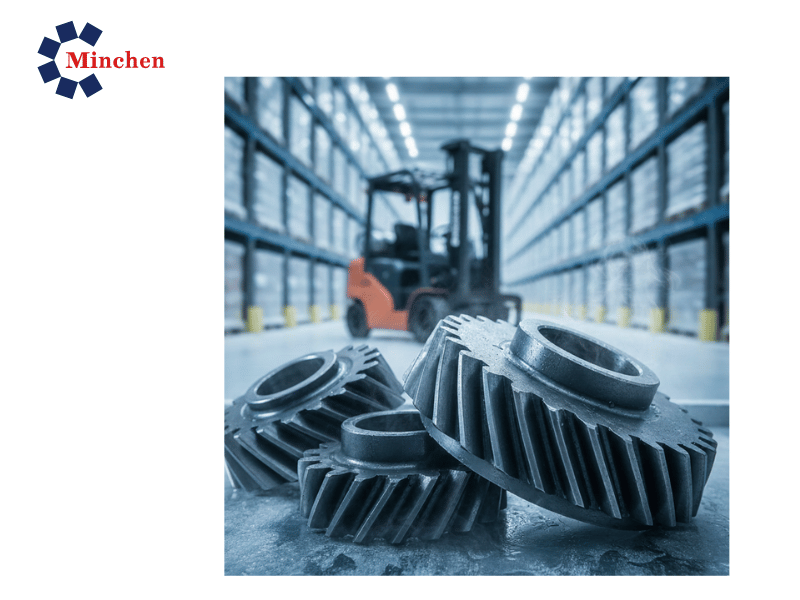
Advanced Engineering for Low-Temperature Performance
At MINCHEN GEAR, we approach the sub-zero challenge through a multi-dimensional engineering strategy. Standard gear manufacturing often fails in cold environments because it ignores the synergy between material physics, thermal contraction, and lubrication dynamics. Here is how our advanced engineering sets a new industry standard:
1. Material Science & Grain Refinement: Defeating the DBTT
The core challenge in cold storage is the Ductile-to-Brittle Transition Temperature (DBTT). At standard temperatures, alloy steel can deform slightly to absorb shocks; however, below the DBTT, it fractures like glass. MINCHEN GEAR mitigates this through superior metallurgy:
- Specialized Ni-Cr-Mo Alloy Selection: We utilize high-purity Nickel-Chromium-Molybdenum alloys (such as SNCM420). Nickel is essential for lowering the DBTT, ensuring the gear core retains high Charpy impact values even at -40°C.
- Fine Grain Structure Control: During the forging and normalized stages, we implement strict temperature controls to achieve a fine-grained microstructure. Smaller grain sizes provide more barriers to crack propagation, which is vital when a forklift carrying a 3-ton load accelerates suddenly in a freezer.
- Vacuum Degassing Technology: By removing dissolved gases and non-metallic inclusions during the steel-making process, we eliminate microscopic "stress raisers" that trigger cold-induced cracks.
2. Deep Cryogenic Treatment: Total Molecular Stabilization
Standard heat treatment often leaves a percentage of "Retained Austenite" within the steel, which is unstable and can cause dimensional changes over time. MINCHEN GEAR employs a rigorous Deep Cryogenic Treatment process:
Gears are gradually cooled to -196°C using liquid nitrogen. This ultra-low temperature soak ensures a near-100% conversion of austenite to martensite. For a forklift gear, this means unmatched dimensional stability. Without this process, the gear could literally "grow" or "shrink" microscopically during temperature cycling, leading to gear jamming or excessive backlash.
3. Micro-Geometric Compensation for Thermal Contraction
One of the most overlooked aspects of cold-storage engineering is the Differential Thermal Contraction between the gear, the shaft, and the housing. In a sub-zero environment, a cast-iron housing may contract at a different rate than a steel gear shaft, causing misalignment. MINCHEN GEAR solves this through:
- Advanced Tooth Crowning: We modify the gear tooth longitudinal shape (crowning) to ensure that the contact patch remains centered on the tooth even if the housing flexes or contracts in the cold.
- Lead & Profile Modification: We apply micro-level adjustments to the tooth lead and profile to compensate for the higher torque loads required to move thickened, high-viscosity lubricants in the cold.
4. Tribology & Surface Integrity: Ra 0.4 Super-Finishing
Lubrication is a major hurdle; at sub-zero temperatures, gear oil viscosity can increase by over 1000%, leading to poor flow and "dry starts." To counter this, we implement:
- Precision Grinding (Ra 0.4): Our Reishauer grinding machines achieve a mirror-like finish. A smoother surface (low Ra value) allows for the maintenance of a consistent hydrodynamic oil film, even when the lubricant is thick and sluggish.
- Compressive Stress Engineering (Shot Peening): We utilize high-intensity shot peening at the tooth root. This introduces a layer of beneficial compressive residual stress, which acts as a "safety net" to prevent fatigue cracks from initiating in brittle, cold metal.
FAQ: Expert Insights on Cold-Storage Transmission
Q1: Why do standard OEM gears often fail prematurely in cold chain applications?
Failure is usually due to poor material purity or a lack of cryogenic stabilization. Without these, the steel becomes brittle and develops micro-fractures under the high-torque demands of electric motors. MINCHEN GEAR addresses this through rigorous material testing and thermal processing.
Q2: How does temperature affect the noise levels (NVH) of forklift gears?
Cold temperatures change the clearances between parts and the way vibration travels through the lubricant. Our high-precision grinding (DIN 5/6) ensures that MINCHEN GEAR products remain quiet and smooth regardless of the ambient temperature.
Q3: Can MINCHEN GEAR provide custom gear ratios for specialized AGVs?
Yes. We offer full Custom Gear Design services. Whether you need specific ratios for high-torque lifting or high-speed transport in automated warehouses, our engineering team can provide a tailor-made solution.
Q4: What quality certifications do your forklift gears hold?
All MINCHEN GEAR products are manufactured under ISO 9001:2015 standards. We utilize advanced Gear Inspection Centers to provide full traceability and accuracy reports for every shipment.
Conclusion: Empowering the Future of Logistics
As the logistics industry moves toward higher levels of automation and stricter temperature controls, the demand for "zero-failure" components has never been higher. At MINCHEN GEAR, we don't just manufacture parts; we engineer reliability. Our deep understanding of cold-environment mechanics allows us to deliver forklift gears that empower your equipment to perform at its peak, day and night.
Invest in the longevity of your fleet and the safety of your operations. Choose MINCHEN GEAR as your trusted transmission partner.
Visit our Forklift Gear Product Page or Contact MINCHEN GEAR today to speak with an application engineer. Let's optimize your logistics power together!
 BACK
BACK