

Helical vs. Straight vs. Ground Spiral Bevel Gears: Which One Powers Your Power Tools Best?
Among the most commonly used gears in handheld or portable tools are helical gears, straight bevel gears, and ground spiral bevel gears. While all serve the same fundamental purpose of transmitting motion and torque, their design and behavior under load vary significantly. This article explores their differences, advantages, and where each gear type fits best in power tool applications.
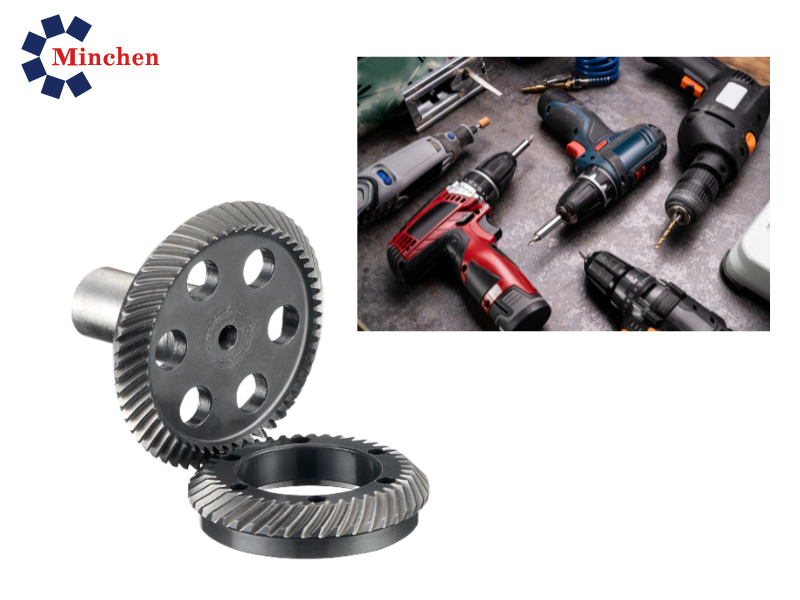
Helical Gears: The Quiet Force for Inline Drives
Helical gears feature angled teeth that engage gradually, providing smoother and quieter operation than spur or straight bevel gears. This makes them particularly suitable for inline power transmission—common in drills, angle grinders, and screwdrivers.
- Advantages: Low noise, high efficiency, strong torque transfer.
- Limitations: Axial thrust requires stronger bearings, not ideal for right-angle drives.
- Best for: Inline drills, sanders, rotary cutters, screwdrivers.
Straight Bevel Gears: Simplicity for Angular Transmission
Straight bevel gears are designed to transfer motion between intersecting shafts, typically at a 90-degree angle. With straight teeth converging at a common point, they’re simpler to manufacture and install.
- Advantages: Cost-effective, easy to produce, good for low-speed tools.
- Limitations: Noisy, not suitable for continuous high-torque use.
- Best for: Basic angle grinders, circular saws, low-cost power tools.
Ground Spiral Bevel Gears: Premium Precision and Power
Ground spiral bevel gears are high-precision bevel gears with curved teeth, processed through gear grinding. They offer smooth, quiet, and highly efficient torque transfer.
- Advantages: Superior surface finish, high torque capacity, low backlash.
- Limitations: Higher cost, more complex assembly requirements.
- Best for: Premium-grade power tools, demolition tools, heavy-duty grinders.
Gear Type Comparison Table
| Gear Type | Noise Level | Load Capacity | Gear Angle Support | Manufacturing Cost | Best Use Case |
|---|---|---|---|---|---|
| Helical Gear | Low | High | Inline | Medium | Drills, polishers, sanders |
| Straight Bevel Gear | High | Medium | 90° transmission | Low | Angle grinders, circular saws |
| Ground Spiral Bevel Gear | Very Low | Very High | 90° transmission | High | Premium-grade tools with high torque |
Which Gear Should You Choose?
Here are some quick recommendations based on your product design needs:
- Need quiet operation? Choose helical or ground spiral bevel gears.
- Building a basic cost-effective tool? Straight bevel gears may suffice.
- For high-torque tools with professional demands: Ground spiral bevel gears are your best bet.
- For inline tools: Go with helical gears for compact and smooth performance.
Conclusion
Each gear type offers a unique balance of performance, cost, and complexity. While straight bevel gears serve basic needs, helical and ground spiral bevel gears provide enhanced performance and precision. For manufacturers developing next-generation power tools, understanding these differences is key to building better, more competitive products.
Minchen Gear Co., Ltd. specializes in manufacturing all three gear types with precision and durability in mind. Contact us today to explore custom solutions that power your tools with confidence.